Showing posts with label Individual Counseling. Show all posts

Thursday, October 11, 2012

Sometimes all you need is....bubbles!


I have a lot of practicum students that when making their initial transition from book learning to application, naturally feel reserved and hesitant when approaching their first individual counseling session. How do I get students/clients to open up and talk to me? How do I apply theory to practice? How do I know if I'm asking the right questions? These are all normal feelings and questions newbies experience and with time and practice the comfort and confidence comes.

I love when situations that arise for practicum/internship students come up in my own practice as a counselor. Recently, I was working with a 7 year old client that frequently broke out into tears, didn't talk, and was overall emotionally immature for their age. These clients can be quite hard to work with because how can you help them work through a problem when you don't know what the problem or cause of the problem is?! When working with this client, I decided to "get back to basics" and really take the extra time to work on forming a connection. To do this, I used bubbles. We simply sat together and blew bubbles. After a few minutes, I noticed the clients expression and demeanour became more relaxed and calm. The second time I did this with them, I simply asked an open ended question, "How has your day been?" and they started talking, and talking, and talking!!

By allowing clients, especially younger clients, to be physically engaged in an activity; drawing, playing with sand, blowing bubbles, or using some other manipulative, they naturally become more relaxed and expressive. Building a positive rapport with all clients you work with is the foundation of the helping relationship. While doing this you get to know them, their interests, how they handle different situations, and their outlook on life. With this information and established relationship you're able to help them work through their presenting issues. The questions from my practicum students and the recent client situation I had served as great reminders to "get back to the basics" and slow down to build that relationship with clients (which might take longer for some than others) while doing something interactive and fun. So, whether you're a new or seasoned counselor; remember to work on building a rapport with your clients and when in doubt...get out the bubbles!

Sunday, October 23, 2011

Conflict Resolution Extension Lesson

Due to the schedule (and large number of students) at our school, there are a few classes I see more frequently than others. I use this to my advantage to try out new activities and based on student response, determine if they're worthy of doing with other classes.

This past week I did an extension lesson of the conflict resolution lesson I completed last month. To do this, I used a fantastic resource called Counseling on the Wall. This resource has lesson plans and activities on a variety of topics while also allowing you to display them to advertise/reference those strategies at a later time. The included CD allows you to print all that you need for your bulletin board so it's user friendly and time efficient!


For this lesson we reviewed Kelso and the conflict resolution wheel of choices for solving small problems. We then talked about the importance of calming down before solving a problem to avoid saying or doing something we might regret (not allowing your anger/frustration interfere with solving the problem). We then discussed ways to calm down and relax and I introduced 'The Peace Train' from the Counseling on the Wall book. After discussing the possible techniques to calm down as suggested by the peace train, I distributed blank 'tickets' for students to write things they do to calm themselves down. Students had the opportunity to share their wonderful ideas including; play with my dog, go for a walk, play sports, draw, read a book, etc. I encouraged all students to actively listen (eyes on speaker and avoid distracting those around them) to gain other ideas/suggestions they might not have thought of to calm down. With the remaining time we used the Kelso Conflict Resolution thumb ball to finish our review of conflict resolution.


I displayed in my 'counseling cottage' The Peace Train for students to see when they come to classroom guidance and small group counseling. I left some space to add more 'tickets' from students that I talk with during individual counseling that need assistance with dealing with anger. More tickets could also be added from individuals that participate in an anger group. I look forward to displaying more Counseling on the Wall for students to reference when working with me!

Tuesday, October 18, 2011

'Intro to the Counselor' Lesson

For the first classroom guidance lesson each year I share with students what my job is as a SCHOOL counselor, (more details on that later!) ;) procedures/expectations for the 'counseling cottage' that align with the school PBIS motto (that our school R.O.C.K.S.), and most importantly how to request to come and talk. I share with students that I'm an adult that cares and want to hear about good AND not so good things going on in their life. I do this to build rapport and to let students know that I'm not just someone that listens/helps with their problems- I want to hear about their successes too! In every classroom there is an envelope with "I would like to see the Counselor" slips in them. I inform the students that during NON-instructional time they can fill out one of the slips and either 1. give it to their teacher to give to me or 2. put it in the envelope on my office door. I also share with the students that if they have an emergency (that involves safety, them or someone else getting physically hurt) to NOT fill out a note. If they have an emergency, they need to tell their teacher or another adult that they have an emergency and need to see the counselor right away. We then work together to make sure they see me or my co-counselor that day. As you might imagine, the notes certainly pile up but we make sure to get to everyone as soon as we can. It's a great way for students to self monitor their needs and to know they have an objective adult in their life they can trust. It's also a great way to 'advertise' ourselves to students- sharing with them what our role is. Early in the year we also give teachers referral forms to use when they have a student they feel would benefit from seeing us.


At the end of the lesson we do a 'getting to know you' activity with my infamous 'thumb ball' the kids LOVE it and ask to use it often. Some students have even asked where I got it so they can get one! It's a great tool to use to get to know students, as an icebreaker, and even as an incentive for following classroom procedures and finishing the lesson with extra time remaining!


When meeting with the young students we are a bit more creative with our approach and how we share what we do. To do this and keep the students engaged, we compare ourselves to Mrs. Potato Head! We ask the students how we are like Mrs. Potato Head and they certainly give creative responses. :) Then we go into detail about how our job and what we do is comparable to Mrs. Potato Head, for example we have ears to listen to students, hands to 'lend a helping hand' when students are in need of help or to give 'high fives' to celebrate successes with them, the glasses are to help students see more clearly and gain a different perspective to the problem they have, the purse/bag is full of tools and ideas to help students work through their problems, etc. The students really get into it and it also allows students to take turn and celebrate differences (i.e. what one student might select for the hat might be different from another student). I've also heard of counselors using a beach bag of tools that relate to their job, you can even use a beach ball and add questions to the different sections much like the thumb ball.


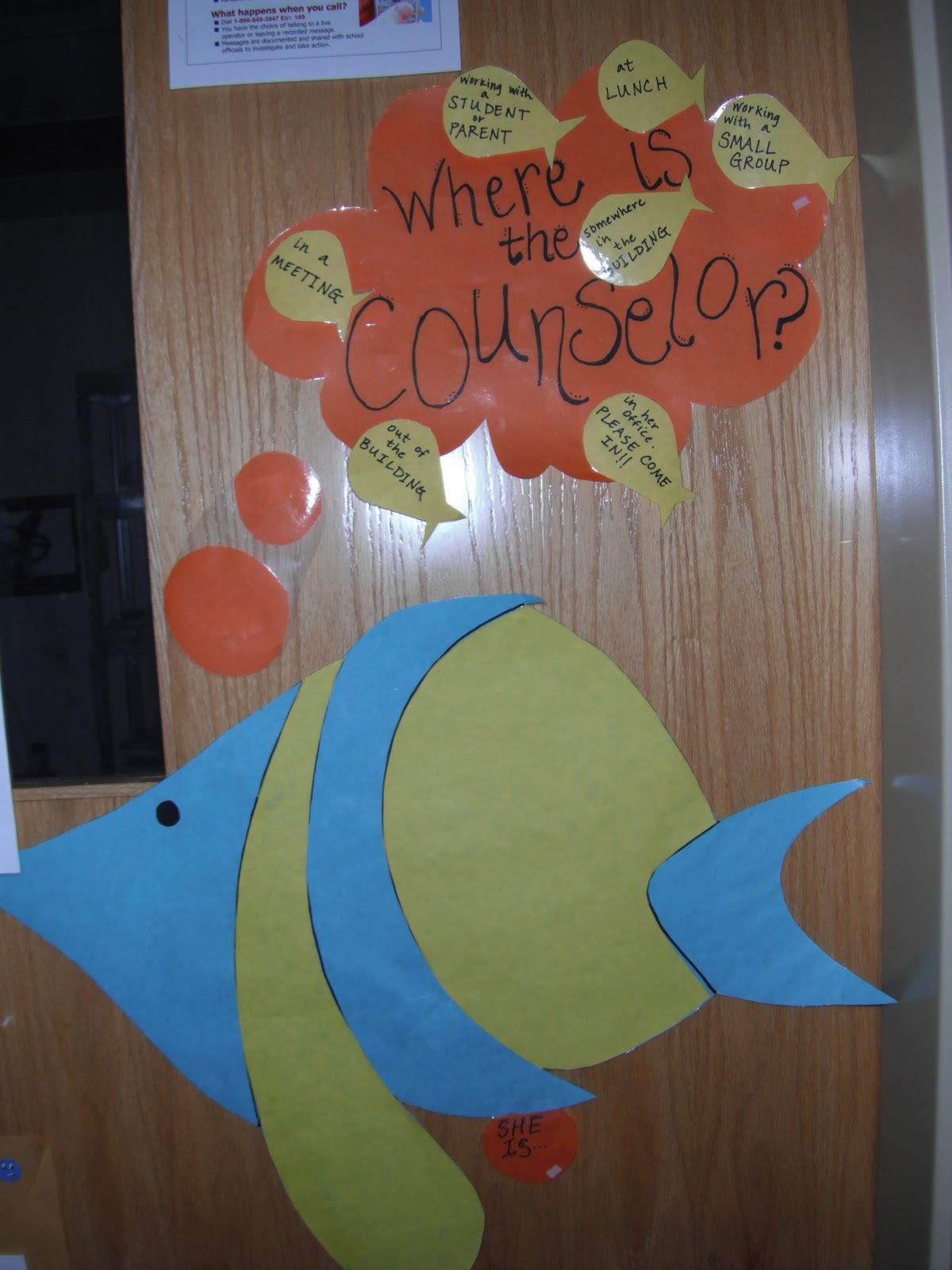
Another way we advertise our comprehensive program and all the components of our job, while also letting people know where we are is through our "Where is the Counselor" door sign. I made the apple sign my first year as a counselor and used library pockets to demonstrate where I was in the building. Since it's one of the first things I made as a counselor, it means a lot to me and it has traveled with me to every school I've been at. When I was split between two schools I wanted one for my other office so I made a fish and used Velcro to show where I was in that building. It's now in the safe possession of my co-counselor.


Monday, October 10, 2011

Conflict Resolution/Problem Solving

I've just completed my second rotation of classroom guidance and the topic was conflict resolution and problem solving. I usually do this lesson later on in the semester but after collaborating with some teachers and my co-counselor, it was determined that it would be more beneficial to do earlier in the year. Since I became a full time counselor six years ago, I've been implementing the program I'm about to describe and I absolutely LOVE it, it's developmentally appropriate, easy to understand, and can be implemented school wide. Teachers especially like it because it helps the students work to solve their own problems.

The program is called Kelso's Choices and comes with multiple posters, a DVD, a puppet, a storybook, curriculum manual, and a CD to print reproducible pages for distribution. It's a bit expensive but through collaborating with our generous PTO, they were able to purchase the program for us!

What it's all about: During the lesson we first discuss what conflict is and how since we're all different and unique- disagreements and problems come up from time to time and it's what you do to solve it that counts! Students are informed that they all have the skills to work through their own problems they just need to figure out what works best for them and that situation. All problems are broken down into two categories; small problems and big problems. Big problems are problems that involve safety (them or someone else getting physically hurt) or when two or more choices are unsuccessful at solving a small problem. The only solution for a big problem is to tell an adult they trust because the problem is too big for them to solve on their own. All other problems are considered small problems and they can try different strategies to work through it themselves before getting an adults help. During the lesson we watch the DVD that describes this in more details then afterwards have a discussion, do some role-playing of different scenario's, and discuss "I" messages for effective communication.

HIGHLIGHT for Teachers and Parents: When a student or child comes to you with a problem that doesn't involve safety ask them, "What did you do to try to solve the problem?" If they don't mention several strategies 'on the wheel' tell them to refer to the wheel to help them solve the problem. Encourage them that they have the ability to work through the problem and also tell them that if they still have the problem after trying several possible solutions to then let you know so you can brainstorm together to solve the problem.

All teachers were supplied with a copy of the wheel to post in their classroom, if you'd like an extra copy or would like to implement the program at home let me know and I'll get you a copy of the wheel!

HIGHLIGHT for Counselors: I often refer to 'the wheel' when I do individual and small group counseling. I have a poster displayed in my office and classroom for reference.


5th grade lesson:

I purchased a curriculum last year that I've used in individual counseling and have been excited to use in classroom guidance, after some brainstorming I adapted it for a 40 minute classroom guidance lesson for 5th graders and it went well! One of my favorite counseling writers is Diane Senn and you'll see me refer to her a lot here on the blog. Some of my counselor friends and I often refer to her by first name as if we know her personally or she's one of our dearest friends, we do that with a lot of others including Danielle (from school counselor blog) and 'the Julia's' (Julia Taylor and Julia Cook)....we get a good laugh out of it but what can I say- their stuff is good and we referred to them a lot.

Anyway, the book I used for this lesson was Coping with Conflict and I used it to create a "Timely Tools Box," it included laminated conflict resolution cards and "Timely Tools Conflict Cards." For the lesson, I distributed the resolution cards around the classroom and each student that had one stood up, showed it to the class, and read the description on the back (there were about 16 total). After all the possible solutions were shared and discussed the remaining students received a conflict card that they took turns reading. They then chose a possible solution they would use if they had that problem. This lesson was great because it gave ALL the students in the class an opportunity to participate. Students were encouraged to keep an open mind because how a classmate might solve a problem might be different from them. This was a great way for them to see all the different ways different problems could be solved!


To purchase these resources and to see other conflict resolution resouces click here.