
Sunday, October 30, 2011
Food Drive Results
This week also concluded the Thanksgiving Food Drive collection for the Salvation Army that we had for the past three weeks. I'm proud to report that as a school, we collected 1,080 non-perishable items to support members of our community! Great job everyone and thanks for your support with this initiative.


Red Ribbon Recap!
Monday
To kick-off RRW we had a PBIS assembly where HTCs Nicole Hyman came with McGruff the crime dog and members of the fire department talked with students about safety.


Students also received Red Ribbons that said they show 'Good Character' by being Drug Free! (It was a great continuation from Character Counts Week.)

Tuesday
 |
| "Sock it to Drugs Day!" AKA "Crazy Sock Day!" |
 |
| "Put a Cap on Drugs Day!" |
 |
| Gotta love faculty participation! |
 |
| "Slam Dunk Drugs are Junk" |
 |
| Students enjoyed showing off their favorite sports teams! |
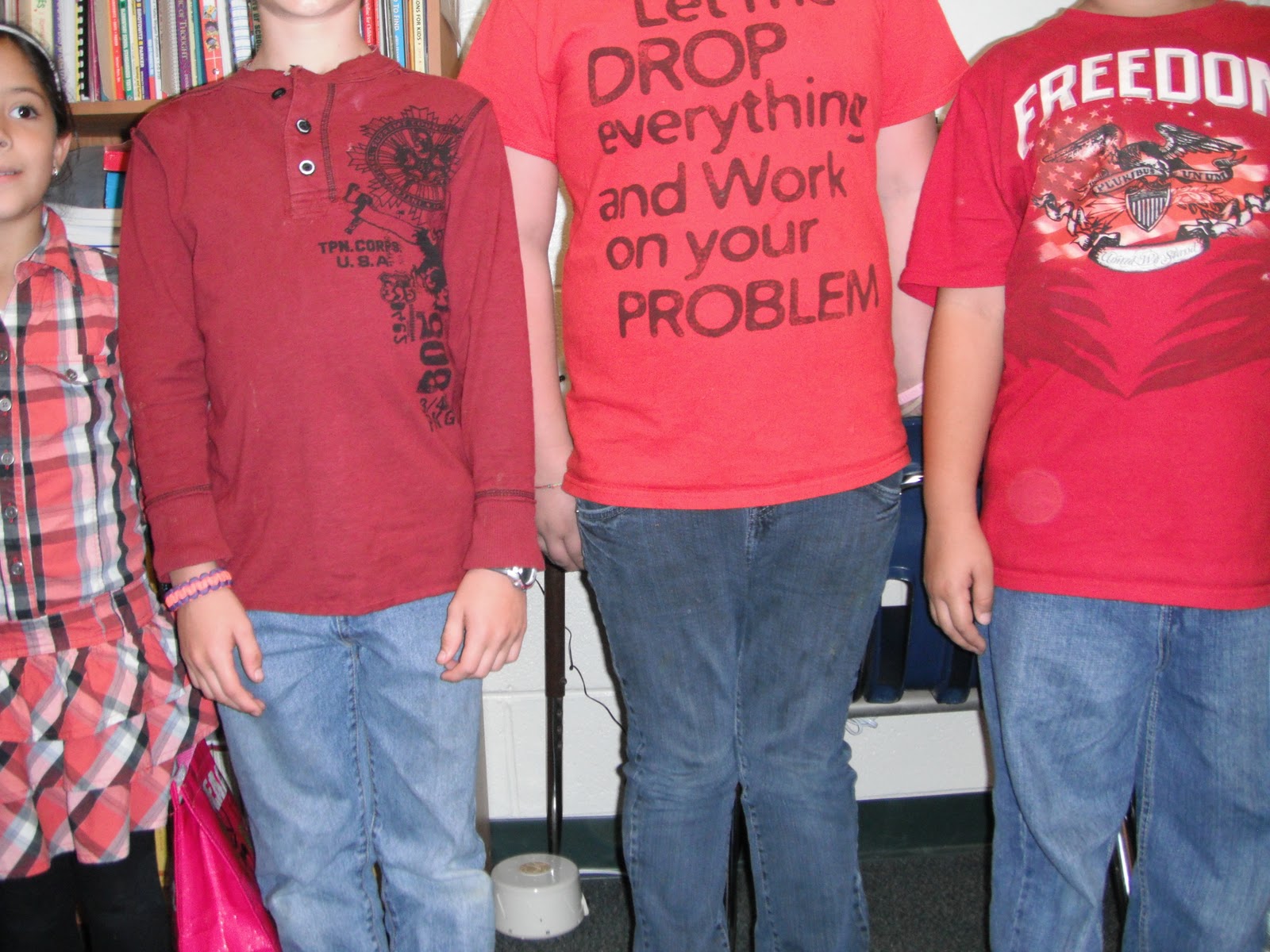 |
"Everyone Wear Red Day!"  |
Thursday, October 27, 2011
2nd & 5th Bullying Lesson
2nd grade
This week 2nd graders had the opportunity to participate in a classroom guidance lesson that promoted bullying awareness. Much like the 1st grade lesson, students were informed of what the words bully, bystander, and target/victim meant, then participated in a role-play with the counselor as the 'bully,' one student as the 'victim,' and several other students as the 'bystanders.' (It's never good to have a student play the bully or for a timid student to play the victim.) The role-play involved the 'bully' saying something along the lines of "Give me your lunch money!" and the rest of the students playing along. It was a nice visual for students to understand what all the terms meant and they enjoyed 'playing' their role. To reinforce student understanding of the terms, the WONDERFUL story "The Bully Blockers Club" was read to the students and they completed the 'Bully Blocker Bingo' activity from the book, "That's My Story Too!". A parent letter was sent home with students that was photocopied on the backside of the bingo sheet to educate parents on what bullying is and how to provide support for their children if they ever feel their child is a victim of bullying. At the end of the lesson students had the opportunity to sign the pledge against bullying a receive a "Take a stand, lend a hand against bullying" sticker.
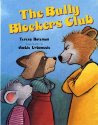

This week 2nd graders had the opportunity to participate in a classroom guidance lesson that promoted bullying awareness. Much like the 1st grade lesson, students were informed of what the words bully, bystander, and target/victim meant, then participated in a role-play with the counselor as the 'bully,' one student as the 'victim,' and several other students as the 'bystanders.' (It's never good to have a student play the bully or for a timid student to play the victim.) The role-play involved the 'bully' saying something along the lines of "Give me your lunch money!" and the rest of the students playing along. It was a nice visual for students to understand what all the terms meant and they enjoyed 'playing' their role. To reinforce student understanding of the terms, the WONDERFUL story "The Bully Blockers Club" was read to the students and they completed the 'Bully Blocker Bingo' activity from the book, "That's My Story Too!". A parent letter was sent home with students that was photocopied on the backside of the bingo sheet to educate parents on what bullying is and how to provide support for their children if they ever feel their child is a victim of bullying. At the end of the lesson students had the opportunity to sign the pledge against bullying a receive a "Take a stand, lend a hand against bullying" sticker.

5th grade
This week in classroom guidance, 5th grade students learned about bullying and spent a lot of time discussing what a bystander is. Students had the opportunity to read "Good-bye Bully Machine" and discuss how they are the ones in the school building that have the power to make the school bully-free. The bully machine is a large, cold, loud, and fearful machine that operates on students being mean, hurtful, and negative towards others. To make the machine break down and not work, students need to stand together and not let bullying happen. By taking a stand against bullying, it is less likely to occur because it isn't accepted and it teaches the bully the way others expect to be treated....with RESPECT! To reinforce the topics discussed in the book, question cards from the "Good-bye Bully Machine" card game were distributed to each group and they had the opportunity to 'think, pair, and share' what they would do in different scenarios. Students then completed the "Build a Bully Machine" activity from the FreeSpirit leaders guide with a copy of the bully word search on the back of their handout for later reference. Students also received a copy of the "Let's Talk About Bullying and Cyberbullying" activity book from Positive Promotions (purchased by the PTO) while signing the pledge against bullying.

To learn more about this amazing book that I'm so glad I introduced this year, please watch the video below!
Sunday, October 23, 2011
1st & 4th Bullying Lessons
1st grade
For this weeks bullying awareness lesson with 1st grade, the story "Chester Raccoon and the Big Bad Bully" was used to teach students about what a bully, bystander, and target/victim are. To start the lesson, students were informed of what all the words meant, then role-played with the counselor as the 'bully,' one student as the 'victim,' and several other students as the 'bystanders.' (It's never good to have a student play the bully or for a timid student to play the victim.) The role play involves the 'bully' saying something along the lines of "Give me your lunch money!" and the rest of the students playing along. It's a nice visual for students to understand what all the terms mean and they enjoyed 'playing' along. To reinforce student understanding of the terms, the story was then read to the students and discussion questions were asked from the book, "That's My Story Too!". Students then had the opportunity to complete two activity sheets from the Tanglewood Press website, one where they cut and pasted positive things to cover up or "Get Rid of the Bully!" In the other activity sheet, students identified what they would do if someone bullied them. Student's then signed the pledge banner against bullying and received a 'take a stand, lend a hand' sticker (purchased by the PTO).

4th grade
This week in classroom guidance, 4th graders discussed the difference between a bully, bystander, and target/victim and read "Nobody Knew What to Do: A Story about Bullying." Through discussion questions from the book, "That's My Story Too!" students spent a lot of time on what a bystander is, reasons why people stand by and let things happen that they know is wrong, and most importantly- all the ways they can 'speak up' without having to necessarily say something directly to the individual that is bullying. The extension activity in the "That's My Story Too!" book was then used, where students identified ways to 'stop' bullying and each table had the chance to read a scenario card and share with the group what they would do to solve that problem. At the end of the lesson students had the opportunity to sign the pledge banner against bullying and receive a copy of the cyberbullying activity book from Positive Promotions (purchased by the PTO).


For this weeks bullying awareness lesson with 1st grade, the story "Chester Raccoon and the Big Bad Bully" was used to teach students about what a bully, bystander, and target/victim are. To start the lesson, students were informed of what all the words meant, then role-played with the counselor as the 'bully,' one student as the 'victim,' and several other students as the 'bystanders.' (It's never good to have a student play the bully or for a timid student to play the victim.) The role play involves the 'bully' saying something along the lines of "Give me your lunch money!" and the rest of the students playing along. It's a nice visual for students to understand what all the terms mean and they enjoyed 'playing' along. To reinforce student understanding of the terms, the story was then read to the students and discussion questions were asked from the book, "That's My Story Too!". Students then had the opportunity to complete two activity sheets from the Tanglewood Press website, one where they cut and pasted positive things to cover up or "Get Rid of the Bully!" In the other activity sheet, students identified what they would do if someone bullied them. Student's then signed the pledge banner against bullying and received a 'take a stand, lend a hand' sticker (purchased by the PTO).
4th grade
This week in classroom guidance, 4th graders discussed the difference between a bully, bystander, and target/victim and read "Nobody Knew What to Do: A Story about Bullying." Through discussion questions from the book, "That's My Story Too!" students spent a lot of time on what a bystander is, reasons why people stand by and let things happen that they know is wrong, and most importantly- all the ways they can 'speak up' without having to necessarily say something directly to the individual that is bullying. The extension activity in the "That's My Story Too!" book was then used, where students identified ways to 'stop' bullying and each table had the chance to read a scenario card and share with the group what they would do to solve that problem. At the end of the lesson students had the opportunity to sign the pledge banner against bullying and receive a copy of the cyberbullying activity book from Positive Promotions (purchased by the PTO).

Conflict Resolution Extension Lesson
Due to the schedule (and large number of students) at our school, there are a few classes I see more frequently than others. I use this to my advantage to try out new activities and based on student response, determine if they're worthy of doing with other classes.
This past week I did an extension lesson of the conflict resolution lesson I completed last month. To do this, I used a fantastic resource called Counseling on the Wall. This resource has lesson plans and activities on a variety of topics while also allowing you to display them to advertise/reference those strategies at a later time. The included CD allows you to print all that you need for your bulletin board so it's user friendly and time efficient!

For this lesson we reviewed Kelso and the conflict resolution wheel of choices for solving small problems. We then talked about the importance of calming down before solving a problem to avoid saying or doing something we might regret (not allowing your anger/frustration interfere with solving the problem). We then discussed ways to calm down and relax and I introduced 'The Peace Train' from the Counseling on the Wall book. After discussing the possible techniques to calm down as suggested by the peace train, I distributed blank 'tickets' for students to write things they do to calm themselves down. Students had the opportunity to share their wonderful ideas including; play with my dog, go for a walk, play sports, draw, read a book, etc. I encouraged all students to actively listen (eyes on speaker and avoid distracting those around them) to gain other ideas/suggestions they might not have thought of to calm down. With the remaining time we used the Kelso Conflict Resolution thumb ball to finish our review of conflict resolution.

I displayed in my 'counseling cottage' The Peace Train for students to see when they come to classroom guidance and small group counseling. I left some space to add more 'tickets' from students that I talk with during individual counseling that need assistance with dealing with anger. More tickets could also be added from individuals that participate in an anger group. I look forward to displaying more Counseling on the Wall for students to reference when working with me!
This past week I did an extension lesson of the conflict resolution lesson I completed last month. To do this, I used a fantastic resource called Counseling on the Wall. This resource has lesson plans and activities on a variety of topics while also allowing you to display them to advertise/reference those strategies at a later time. The included CD allows you to print all that you need for your bulletin board so it's user friendly and time efficient!
For this lesson we reviewed Kelso and the conflict resolution wheel of choices for solving small problems. We then talked about the importance of calming down before solving a problem to avoid saying or doing something we might regret (not allowing your anger/frustration interfere with solving the problem). We then discussed ways to calm down and relax and I introduced 'The Peace Train' from the Counseling on the Wall book. After discussing the possible techniques to calm down as suggested by the peace train, I distributed blank 'tickets' for students to write things they do to calm themselves down. Students had the opportunity to share their wonderful ideas including; play with my dog, go for a walk, play sports, draw, read a book, etc. I encouraged all students to actively listen (eyes on speaker and avoid distracting those around them) to gain other ideas/suggestions they might not have thought of to calm down. With the remaining time we used the Kelso Conflict Resolution thumb ball to finish our review of conflict resolution.

I displayed in my 'counseling cottage' The Peace Train for students to see when they come to classroom guidance and small group counseling. I left some space to add more 'tickets' from students that I talk with during individual counseling that need assistance with dealing with anger. More tickets could also be added from individuals that participate in an anger group. I look forward to displaying more Counseling on the Wall for students to reference when working with me!
Thursday, October 20, 2011
Red Ribbon Week

Each day on the morning announcements there will be a special message regarding Red Ribbon Week. We will also be saying the Red Ribbon Week Pledge after the Pledge of Allegiance. Here is a list of the activities that we are happy to be participating in! As an incentive to promote participation, teachers tally the number of students that participate each day and the top 5 classes that have the most participation will receive a prize and the teachers will receive a duty free lunch!
Below is a list of the activities we will be doing at our school.
Below is a list of the activities we will be doing at our school.
Monday: Everyone receive a Red Ribbon to kick off Red Ribbon Week. Also, students will read then post the Red Ribbon Week History somewhere in their classroom.
Tuesday: “Sock it to Drugs Day!” Everyone will wear the 'craziest' socks they have!!! Students will sign, decorate, and cut out red ribbons, then put them up in the hallway outside of their classroom. We hope to have ribbons up all over the school!
Wednesday: “Put a Cap on Drugs Day!” Everyone wear a hat or cap! Students will read and sign the class pledge to be drug free and post it somewhere in their classroom.
Thursday: “Slam Dunk Drugs are Junk!” Wear a favorite sports team jersey or logo. During writing students will write about why it’s important to be healthy and drug free. Door contest concludes at end of the day.
Friday: “Everyone Wear Red Day!” 3rd annual door contest winners (judged by PTO) will be selected and announced!! (1 winner per grade- classroom prizes awarded)
Other ideas:
Writing Prompts:
“I promise to live a drug free life by…”
“The choice for me is drug free because…”
“If someone asks me to use drugs (including cigarettes) I can say…”
Brainstorming Ideas:
“Ways I can respect myself…”
“Ways I can respect myself…”
“List of better things to do than drugs…”
“How does character tie in with being drug free??
I'm looking forward to posting pictures to showcase all the participation of students and faculty at our school!


School Counselor (yes!) vs. Guidance Counselor (no)


After participating in a counselor tweet chat, I found that many counselors are still faced with the frustrating and oftentimes annoying challenge of being referred to as a 'guidance counselor' below are some of the wonderful and BRIEF explanations of why we should be called school counselors and NOT guidance counselors:
* (classroom) guidance is only ONE component of a counselors job
* guidance is a service, school counselors provide a program
* it's outdated terminology that does not represent the broad scope of what counselors do
* To me I feel that anyone involved in a child's life provides 'guidance' in some way, my expertise allows me to do more than just point them in a productive direction and give a 'quick fix' to a problem their presently working through. My education allows me to assist them in seeing where they've been, what they want to change/keep the same, where they want to go, and help them take the steps to get there. By assisting children through problems they are currently experiencing, it's my hope to teach them the skills and strategies to not only work through their current problem but also those that will present themselves in the future.
So now I hope you have a better concept of the difference between guidance and school counselors. With that said, please stop making us cringe, and start calling us by our appropriate title! :)
Subscribe to:
Posts (Atom)